ARTISANAT DES PRISONNIERS EN ANGLETERRE PENDANT LE 1er EMPIRE . .
NAPOLEONIC PRISONERS OF WAR CRAFTS...
One of the first recycling art.
Artiste et origine exacte souvent inconnus.Artist name and exact origin often unknown.
Spinning jenny de 1809, faite par Etienne Vongurt , prisonnier français en Angleterre pendant les guerres napoléoniennes . NapoleonicPoWSpinningjenny made by Etienne Vongurt 1809.
A collection of Napoleonic prisoner-of-war work, early 19th century,
comprising a bone "Spinning Jenny" automaton with two seated
Breton ladies with spinning wheel above geared mechanism, now on stand
and under glass dome, two bone marrow scoops, a bone cup-and-ball game,
two star-work boxes, a set of bone dominoes in barrel case and another
set of bone dominoes in carved case with sliding lid painted with full
length portraits of a man and a lad, the case 6 1/2in (16.5cm) long (qty)
Heightened in red and blue, the wagon platform on four working spoke
wheels, the delicate fretted sides applied with small tortoiseshell
roundels and joined by turned columns, surrounded by six soldiers
standing guard with moveable arms and carrying bayonettes, enclosing
nine soldiers engaged in a drill, carrying bayonettes and standing
underneath a gate with suspended target. Height 6 ⅛ inches, length 12 ¼
inches.
Origine des plus belles "spinning jennies" (automates), les prisonniers français en
Angleterre , ou les artisans de Méru dans l'Oise avec les ivoiriers de
Dieppe, avant , après 1815 ?
Exemples et contre-exemples
When, where and Who really made
the most beautiful spinning jennies, bone crank automata, napoleonic
PoW in England, or craftsmen of Méru , Oise France with other craftsmen of Dieppe, after or before 1815?
Spinning jenny achetée à Norman Cross par Mr. Wright at Norman Cross. avant 1815.
"The group of figures on a platform (Plate XVI, Fig. 1), is one
of many such mechanical toys or ornaments p. 131known to
the author. This is beautifully preserved, having been kept
in the box in which it was purchased for many years. When
the lower wheel below the platform is turned, by an arrangement
of the threads passing over the wheels, the various figures move,
the lady in the centre turns the winding-wheel, the child moves
forward, the soldier and the lady waltz, the mother tosses her
baby, turning her head to look at it, while the lady on the left
prepares the tea. The owner of this ornament is the
grandson of its purchaser." Thomas James Walker.
"made by French prisoners of war in Carnarvon Gaol and given to the Lord Lieutenant of Carnarvon Castle for his kindness during their captivity" (Welsh: Castell Caernarfon )
Paul Chamberlain, author of 'Hell Upon Water: Prisoners of War in Britain 1793-1815' said:
From 1793 until 1814, over 200,000 French and French allies were held as
PoWs, and whilst it's impossible to put a definite figure on it,
several thousand of them would have been held in Wales.
"L’ivoire est d’abord envoyé dans l’Oise, dans le canton de Méru, pour
être débité, puis retourné à Dieppe pour y être sculpté, et enfin déposé
à Paris..."
Par Anne Doridou_Heim-La Gazette Drouot N°10 du 12 mars 2010
The Prison at Norman
Cross, near Peterborough, was built to hold French and Dutch prisoners
captured during the Napoleonic Wars between 1797 and 1815.
Considered both the largest and finest collection
of such items in the world, the museum displays objects of carved bone
and ivory, including model ships, guillotines, needlework boxes, playing
cards and articles of straw marquetry.
72. Model Cockerel (Life-Size)
Category: Model
Technique: Carved
Material: Bone
Accession Number: PETMG:1996.006
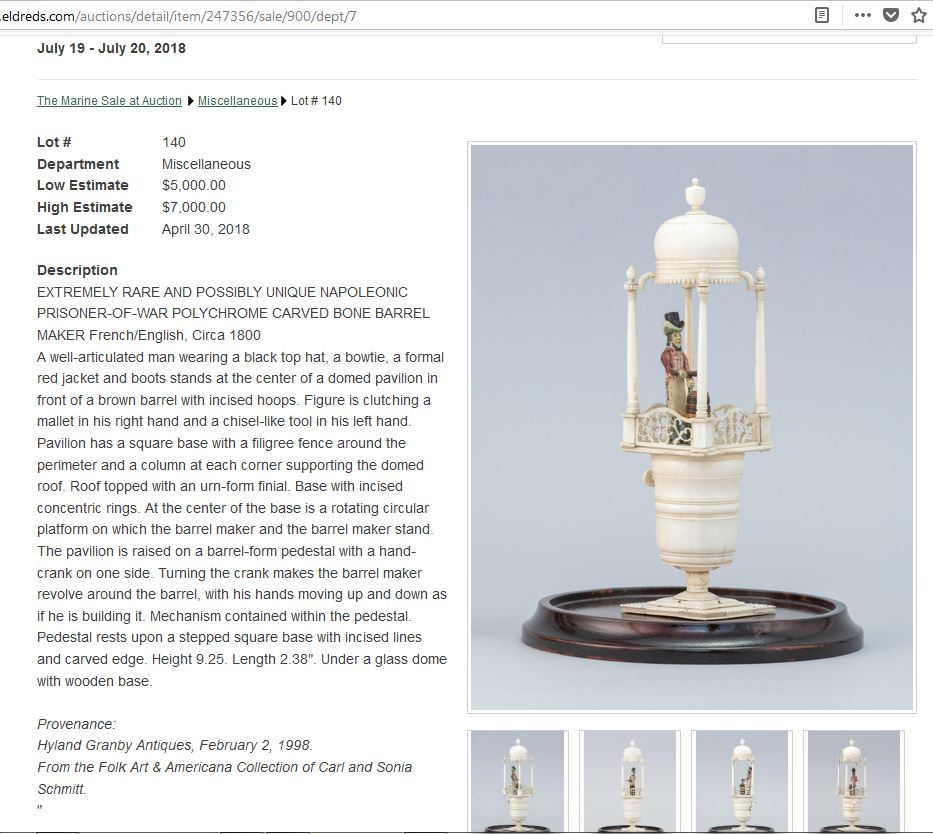
Turning the crank makes the barrel maker revolve around the barrel, with
his hands moving up and down as if he is building it. Mechanism
contained within the pedestal. source
An early 19th century Napoleonic Prisoner of War spinning jenny bone
automaton, French, with two partially painted polychrome Breton ladies,
both sat on high open carved chairs with mechanically moving arms and
head, one making a ball of thread with a short length of twine, the
other working the spinning wheel, together with a painted gentleman with
articulated head, arms and leg, appearing to operate a treadle lathe
and drawknife, all raised on a bordered platform over gears, some losses
and modern repairs, 4½in. (11.4 cm.) high. source : https://www.the-saleroom.com
constructed from a section of shin bone, with lattice cut glazed door
opening to reveal polychrome Calvary scene on a platform painted with
flowers to the front and mounted on three feet, the reverse ornately
carved overall, - 5in. (12.5cm.) high
£700-900 AUCTION ALREADY HELD
2017/08/17
Femmes et enfants prisonniers des pontons, dont Julienne David ...
A Napoleonic prisoner of war bone mechanical drummer boy, early 19th
century, with painted tunic and drum, and standing on box concealing
mechanism, with crank handle to side, 10.5cm high
CARVED BONE MODEL OF A PERPETUAL MOTION ENGINE AND WHEEL ( ???? )
(artistes, lieu, et date inconnus)
Mounted in a glass case with molded wooden base, the base affixed
with a bone panel engraved “Perpetual Motion.” Height of case 8 ¼
inches, length 16 inches, width 9 inches.
Provenance: Rafael Osana Auctions, Nantucket, Massachusetts.
Automate en os à cinq personnages polychromes dit « Spinning
Jenny ». Mécanique à la base actionné par une manivelle. Travail de
ponton. Angleterre Début XIX°. Haut 14,5cm.
Petits accidents et collages. Présenté sous un globe en verre rapporté




 ................;....................................................;;................................


